Using Claude/AI to hunt down my eczema trigger
I have atopic eczema (neurodermitis). To treat a flare my dermatologist prescribes a cortisone cream. It helps, but I can only use it for a short time. As soon as I stop, it comes back. I believe something in my daily life is actively setting the eczema off. My dermatologist wants to do some specific tests (patch test), but these are a couple of months out. I want solutions now, so I did what I now do with most real problems: I opened Claude and started building a plan.
The method
This is the same loop I use for most decisions, pointed at my own skin. It started like this in Claude web/app:
I have neurodermitis. Help me build a structured way to find possible triggers. Generate output as .md files that i can then use to build an app with claude code.
The web chat then turned my problem description into two saved documents: a phased plan for isolating the trigger, and a brief for the tracking app. Those became durable files I could hand to Claude Code as a spec.
The rule I gave it up front was to interview me before doing anything:
Ask me questions wherever you need. Use the ask-user-question tool to finetune the direction before you start. Full build, but check with me on every item (I dont even remember what INCI means).
The plan itself is built on one boring scientific idea: change only one variable at a time, and give the skin a day or three to react before you conclude anything. Mark the days I'm on cortisone, because those mask everything.
Then I moved to Claude Code and we built the tracking app in one evening. Plain PHP and SQLite, running on my own NAS locally. The thing that makes it useful is how much context it captures per day, so a one-to-three-day lag has a chance of showing up:
| Logged | Detail |
|---|---|
| Per-area severity + itch (0–10) | lips / eyes / hands / face / arms |
| Products used (me + partner) | with the ingredient list per product |
| Meals + ingredients | auto-synced from my recipe app (Mealie) |
| Sleep, stress, showered | daily |
| Weather + pollen | auto-pulled, location-aware |
| Cortisone days | flagged (they mask everything) |
| Sport | sweat-in-eyes, clothing fabric |
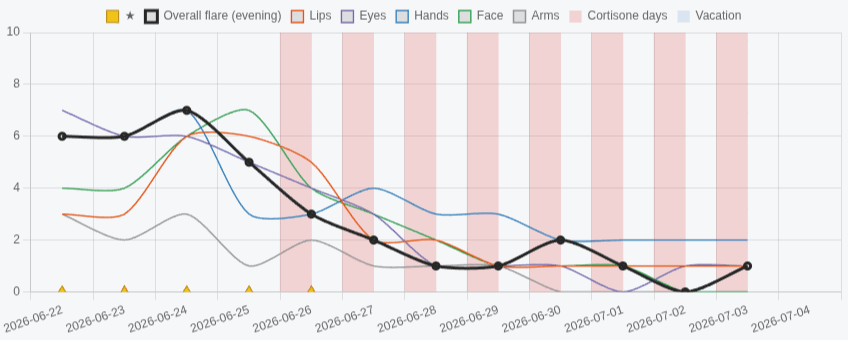
It exports its data so I can feed it back to Claude to hunt for patterns. Build the tool, collect the data, analyze it with AI, refine.
What surprised me
The useful part was that the process kept overturning my own confident guesses. I was sure about a couple of suspects (a deodorant, the laundry detergent). Reading the actual ingredient lists with Claude mostly cleared both.
And it surfaced things I'd never have reached on my own. The best one:
Dishwasher is something that came to me last night, would have never thought about it.
Rinse-aid residue left on the dishes and glasses that touch my mouth all day. It fits the pattern (my lips flare first) and it's exactly the kind of invisible daily contact I'd never suspect. It even flagged that one of the products I was using to treat the skin might be quietly keeping it going, which is a special kind of annoying.
Where it pushed back
After the app was built, I pointed a crowd of agents at my own tool:
Spawn 7–10 analysis agents with different backgrounds, plus 5 data and statistics experts, and have them pressure-test the tool.
The agents pushed back, hard and unanimously. Their verdict: the neat little correlations the app produces can badly mislead you (things that drift together, effects that run backwards, skin that was going to calm down anyway). The only real evidence is the controlled experiment, changing one thing at a time and watching. The tracking just organizes the guessing until then.
So the AI helped me build the tool and then talked me out of over-trusting it. I had it rewrite the analysis page to be honest about small sample sizes and shaky signals. That's the thing I learned about AI at its current state: it's great for structure, research and suspects I'd never reach, but it still needs me in the loop to steer it into the right direction.
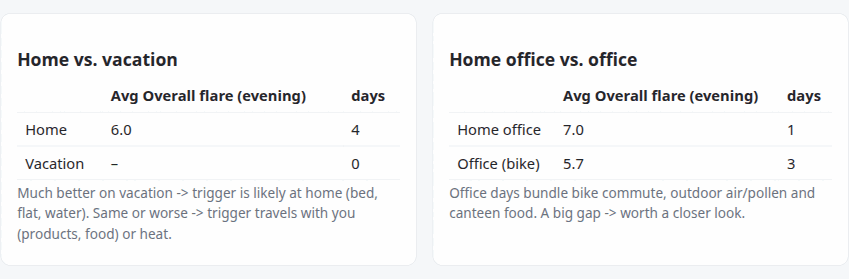
There was a nice side effect too. I talked about this app to a couple of people and a few have shown interest. So I had Claude generalize it, strip my personal data out, and make it something other technically versed people could run. A tiny tool nobody asked me to build that a few people then showed interest in. That doesn't happen to me often, and it's a big part of why this site exists.
Where it stands
Honestly: still running. No confirmed trigger yet. I'm mid-way through a reset, with a vacation coming up that doubles as a natural experiment (different place, same products travel with me), and the careful reintroduction phase is still weeks out. AI didn't diagnose me and it definitely didn't cure me. What it did was turn "my skin keeps flaring and I don't know why" into an actual experiment I can run.
One honest note, since this touches health: this is my own experiment, not medical advice. I'm doing all of it alongside my dermatologist, and I'd tell anyone with the same problem to do the same :)
No responses yet. Be the first :)